 NASDAQSIGNALS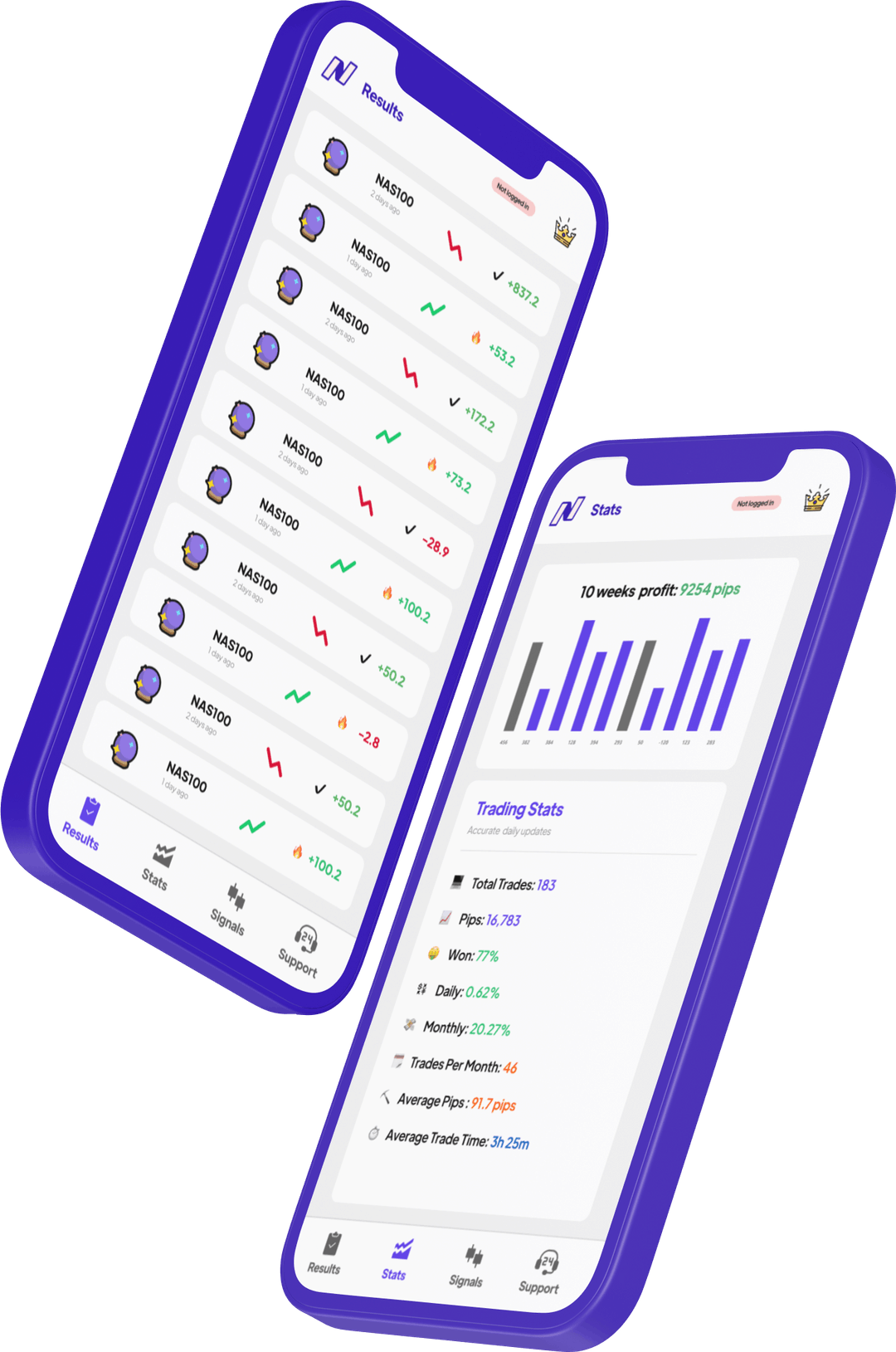
What is NAS100 trading?
NAS100 trading explained
The NAS100 tracks the Nasdaq 100 index — the 100 largest non-financial companies listed on the Nasdaq exchange, weighted by market cap. It trades as a CFD or futures contract through brokers. Unlike stocks, you can trade the index in both directions: buy (long) when you expect tech/growth to rise, or sell (short) when you expect a pullback.
Why trade the NAS100?
- Exposure to top tech companies (Apple, Microsoft, Nvidia)
- Large daily ranges = high profit potential
- Clear fundamental drivers (tech earnings, Fed policy)
- Deeply liquid — tight spreads on every major broker
- Can be traded with leverage for capital efficiency
- Strong long-term uptrend — the index has doubled since 2020
What moves the NAS100 price?
Understanding these drivers is essential for anticipating NAS100 direction.
Fed Policy
The NAS100 is highly sensitive to Fed rate decisions. Dovish signals push the index higher; hawkish surprises trigger selloffs.
Tech Earnings
Apple, Microsoft, Nvidia, and other mega-caps drive the index. Strong earnings season = bullish; misses = sharp corrections.
Market Sentiment
Risk-on sentiment fuels the NAS100. When investors are optimistic about growth, money flows into tech.
Treasury Yields
Rising long-term yields compress tech valuations. Falling 10Y yields are typically very bullish for the NAS100.
Economic Data
NFP, CPI, GDP, and PMI data move the index. The NAS100 responds to anything that shifts Fed rate expectations.
AI & Innovation
Breakthroughs in AI, cloud, and semiconductors drive massive rallies. The NAS100 is the world's technology benchmark.
Watch NAS100 trading in action.
See professional NAS100 signal execution on NasdaqSignals.
NAS100 trading strategies.
Trend Following
Identify the higher-timeframe direction and trade with it. Use moving averages (50/200 EMA) for confirmation.
Breakout Trading
Wait for price to break key support/resistance with momentum. Enter on the break, SL below the level.
Range Trading
During consolidation, buy at support and sell at resistance. Works well in quiet Asian sessions.
News Trading
React to NFP, CPI, FOMC. The NAS100 can move 200+ points in minutes. Requires fast execution and wider stops.
Signal-Based Trading
Let NasdaqSignals analysts do the analysis. Receive entry/SL/TP, copy into your broker. Best for busy traders.
Scalping
Quick 5–30 pip trades on M1–M5 charts during London/NY overlap. High frequency, tight risk.
Protect your capital.
Risk management is more important than any strategy. Follow these rules religiously.
Never risk more than 1–2% per trade
If your account is $10,000, risk max $100–$200 per trade. This keeps you in the game through inevitable losing streaks.
Always use a hard stop-loss
No exceptions. Mental stops don't work. Set the SL in your broker before the trade is live. NasdaqSignals provides one on every signal.
Position size from risk, not greed
Calculate your lot size from your stop distance and risk amount. Never pick a lot size first — let the math decide.
Cut losers fast, let winners run
Move SL to breakeven after TP1 hits. Take partials at TP2. Let the rest ride to TP3. Never add to losing positions.
Live NAS100 levels + signals.
Get auto-calculated support/resistance based on daily pivot points, plus live signals that fire when price approaches these levels. No more watching charts all day.
- → Daily pivot-based S1/S2/R1/R2
- → Signals fire at key levels automatically
- → Session-aware (London/NY overlap prioritised)
- → Lot size pre-calculated for 1% risk
Nasdaq trading questions, answered.
What is NAS100 and how is it priced? +
NAS100 is commonly a broker label for exposure to the Nasdaq-100 index. Index values are measured in points. A broker's CFD quote, the underlying index and NQ or MNQ futures are related but distinct products.
How accurate are NasdaqSignals NAS100 signals? +
NasdaqSignals advertises 93% accuracy for its NAS100 signals. The results archive shows closed setups; use the period and calculation attached to a performance statistic when comparing it with a rolling sample.
What does a NASDAQ-100 trading signal include? +
A NasdaqSignals setup presents the NAS100 direction, entry level, stop loss, take-profit targets and status. The app sends notifications for new and updated setups; orders are placed separately with your broker.
What moves the NASDAQ-100 price? +
Nasdaq-100 prices reflect the constituent companies, their earnings and valuations, interest-rate expectations and investor demand. Large technology and growth companies have substantial influence; currency and geopolitical developments can also affect the index.
How much capital do I need to trade NASDAQ-100? +
The amount of capital needed depends on the product, minimum position size, margin requirement and chosen stop distance. Calculate cash exposure from the actual contract specification and account currency. There is no universal starting balance that suits every broker or trading plan.
Which broker should I use for NASDAQ-100 trading? +
Use a broker that supports your exact instrument and account jurisdiction. Compare its contract size, quote currency, spread, execution platform and trading hours. The app provides analysis and alerts; the broker handles trade execution.
What is the best time to trade NASDAQ-100? +
Active periods depend on the instrument, trading venue and economic calendar. London and New York activity often overlap with major releases. Local session times shift relative to UTC during daylight saving, so use the session's named timezone rather than one year-round UTC window.
Is NASDAQ-100 trading risky? +
NAS100 exposure can change quickly around earnings and economic releases. Position risk depends on the stop distance and the product's dollar value per point. NQ, MNQ and broker NAS100 CFDs have different contract specifications.
Start trading NAS100 today.
Download NasdaqSignals free. Professional signals, no experience needed.