 NASDAQSIGNALS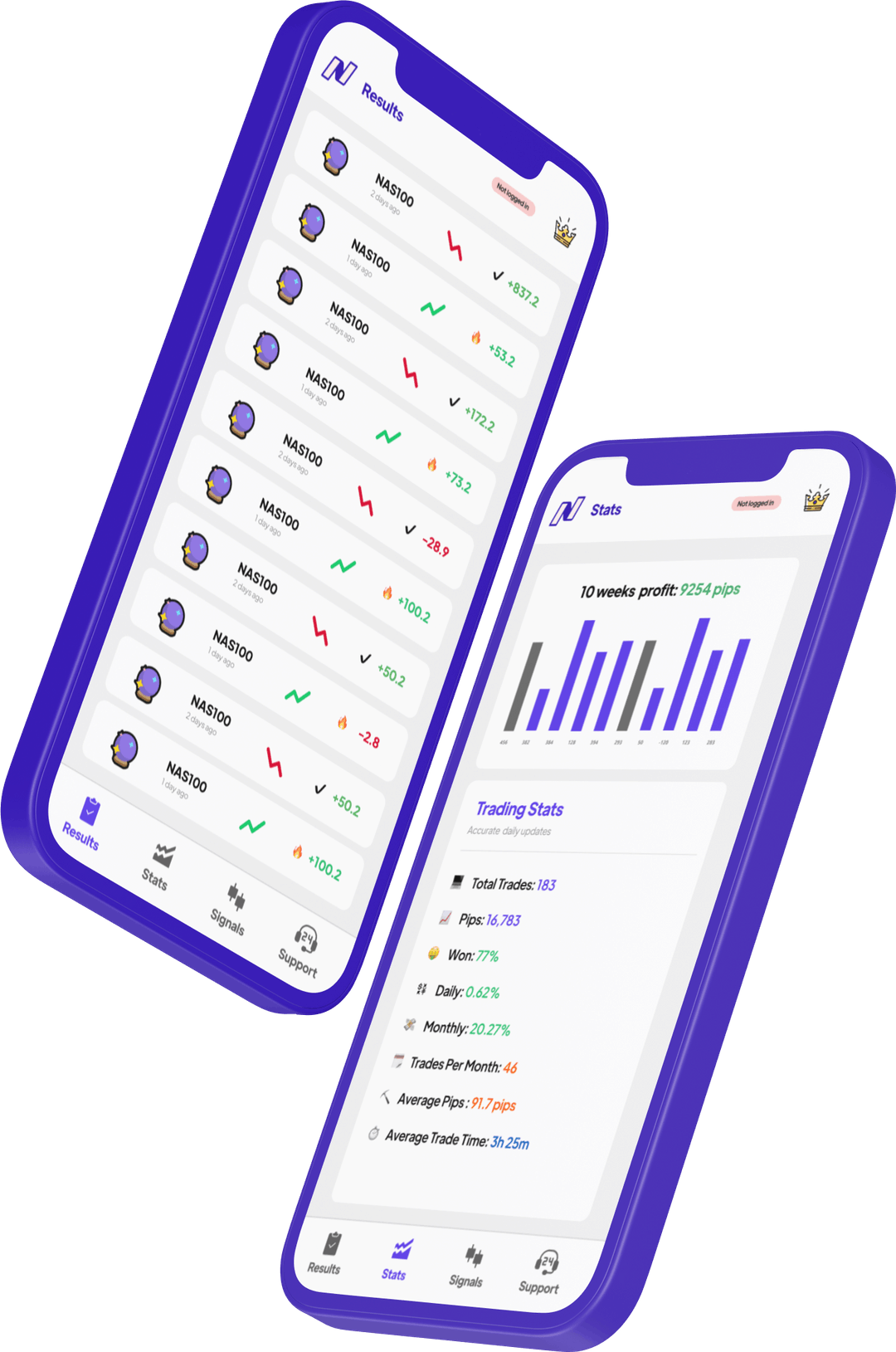
Nasdaq-100 root symbols.
Every Nasdaq-100 trading product starts with a root symbol. The front-month contract appends a month code and year digit — but for signals, analysis, and search, the root symbol is what matters.
| Symbol | Name | Exchange | Type | Pt Value | Tick | Tick $ |
|---|---|---|---|---|---|---|
| NQ | E-mini Nasdaq-100 | CME | Futures | $20 | 0.25 pts | $5.00 |
| MNQ | Micro E-mini Nasdaq-100 | CME | Futures | $2 | 0.25 pts | $0.50 |
| NDX | Nasdaq-100 Index | Nasdaq | Index | N/A | 0.01 | N/A |
| NAS100 | Nasdaq-100 CFD | Broker | CFD | Varies | Varies | Varies |
| US100 | Nasdaq-100 CFD (alt) | Broker | CFD | Varies | Varies | Varies |
| QQQ | Invesco QQQ Trust | NASDAQ | ETF | $1/share | $0.01 | $0.01 |
CME futures month codes.
CME equity index futures use single-letter month codes. Nasdaq-100 contracts (NQ, MNQ) expire quarterly in March, June, September, and December. A full contract symbol combines root + month + year: NQH6 = NQ March 2026.
How to read a full contract: NQM6 = NQ (E-mini Nasdaq-100) + M (June) + 6 (2026). On some platforms the year is two digits; others use four. Most trading platforms auto-select the front month when you type just NQ.
How each platform displays NQ symbols.
NQM6 Root + month code + 1-digit year. Front-month auto-selected. Type "NQ" and the platform fills the rest.
NQ 06-26 Root + space + month-year. Alternatively accepts NQM6 format. Continuous contract: NQ ##-##.
CME_MINI:NQ1! Exchange prefix + root + contract number + ! for continuous. For specific month: CME_MINI:NQM2026.
/NQ Forward slash + root for continuous. For specific month: /NQM26. Micro: /MNQ or /MNQM26.
NQ Root symbol. IB auto-selects the front month. For continuous data use NQ-IND or add @CME suffix.
NAS100 CFD brokers use NAS100, US100, or US100. Not the CME symbol — broker-specific naming.
NQ-202606-GLB Root-year-month-exchange. Or NQ-##-CME for continuous contract.
US100 CFD platforms typically use US100, US100, or NAS100 depending on the broker.
Get live signals for every Nasdaq symbol on this page.
NQ, MNQ, NDX, QQQ — we publish 4–8 signals per session covering every Nasdaq-100 trading vehicle.
Every way traders search for Nasdaq futures.
Traders search for Nasdaq futures signals using dozens of variations. Here is every common naming pattern — these are all covered by our signal pages and glossary.
Nasdaq futures FAQ.
What does NQ stand for in futures trading? ▼
NQ is the CME ticker symbol for the E-mini Nasdaq-100 futures contract. It represents a $20 per point contract tracking the Nasdaq-100 Index. The "E-mini" designation means it is an electronically traded, smaller version of the original full-size contract. NQ is one of the most liquid equity index futures in the world.
How do I read a full NQ contract code like NQH6? ▼
NQH6 breaks down as: NQ (E-mini Nasdaq-100) + H (March — the month code) + 6 (2026). So NQH6 = NQ March 2026 contract. CME equity futures expire quarterly: H = March, M = June, U = September, Z = December. Most platforms auto-select the front month when you type just "NQ".
What's the difference between NQ, MNQ, and NAS100? ▼
NQ is the standard E-mini Nasdaq-100 futures at $20 per point on the CME. MNQ is the Micro version at $2 per point — 1/10th the size. NAS100 is the CFD name used by forex brokers. All three track the identical Nasdaq-100 Index. Choose NQ for larger accounts, MNQ for smaller accounts or scaling, and NAS100 for CFD/flexible sizing.
Can I trade Nasdaq futures on Tradovate or NinjaTrader? ▼
Yes — both Tradovate and NinjaTrader support NQ and MNQ futures. Simply type the root symbol (NQ or MNQ) and the platform auto-selects the front-month contract. Both brokers offer low intraday margins and are among the most popular platforms for Nasdaq futures traders.
Do your signals work for all Nasdaq symbols on this page? ▼
Yes — our Nasdaq signals are based on the Nasdaq-100 Index level and work across every vehicle: NQ futures, MNQ micros, NDX options, NAS100 CFDs, and QQQ ETF. The index level is identical — you simply convert to your specific contract size. Each signal includes entry, stop-loss, and three take-profit targets.
More Nasdaq trading resources.
NQ Futures Signals
Live E-mini Nasdaq-100 trade alerts.
MNQ Futures Signals
Micro Nasdaq-100 signals for smaller accounts.
NDX Signals
Nasdaq-100 Index benchmark signals.
QQQ ETF Signals
Invesco QQQ ETF signals for stock traders.
NAS100 Signals
Live NAS100 CFD signals with 93% accuracy.
What Is the NAS100?
Complete guide to the Nasdaq-100 index.
Gold trading questions, answered.
What is the current gold price per ounce in USD? +
The live XAU/USD gold price updates every 15 seconds on our gold price page. As of May 2026, gold trades above $3,300 per troy ounce. Gold (XAU/USD) trades 24 hours a day, 5 days a week — from Sunday 22:00 UTC to Friday 22:00 UTC. The most liquid sessions are London (07:00–16:00 UTC) and New York (12:00–21:00 UTC).
How accurate are NasdaqSignals XAU/USD signals? +
NasdaqSignals maintains a 93% win rate calculated across all closed XAU/USD trades since 2018. This is verified publicly — every signal (wins and losses) is timestamped and logged in the app. The average winning trade captures 91.7 pips, with an average trade duration of 3 hours 25 minutes. We publish 4–8 signals per trading day.
What does a gold trading signal include? +
Every NasdaqSignals signal includes: exact entry price (or range), stop-loss level, three take-profit targets (TP1, TP2, TP3), suggested lot size based on 1% risk, and the trade direction (BUY or SELL). After entry, we send live management updates — SL adjustments, partial close instructions, and "move to breakeven" alerts.
What moves the gold price? +
Gold (XAU/USD) is primarily driven by 5 factors: (1) US real interest rates — gold is inversely correlated to yields; (2) US Dollar strength (DXY) — weaker dollar = higher gold; (3) Geopolitical risk — wars, sanctions, and elections drive safe-haven demand; (4) Central bank buying — BRICS nations accumulated record gold in 2023–2026; (5) Inflation expectations — gold acts as an inflation hedge when CPI rises faster than expected.
How much capital do I need to trade gold? +
You can start trading XAU/USD with as little as $100–$500 using brokers that offer micro lots (0.01 lot). At 1% risk per trade with a typical 30-pip stop-loss on gold, a $1,000 account would risk $10 per trade with a position size of approximately 0.03 lots. NasdaqSignals signals include lot size recommendations based on your account size.
Which broker should I use for gold trading? +
NasdaqSignals signals work with any broker offering XAU/USD. Popular choices: IC Markets (raw spread $0.05, best for scalpers), Exness (unlimited leverage for pros, instant withdrawals), and Pepperstone (FCA regulated, TradingView integration). Key factors: spread (lower is better — aim for under $0.30), execution speed, regulation, and platform support (MT4/MT5/cTrader).
What is the best time to trade gold? +
Gold is most active during the London-New York overlap (12:00–16:00 UTC), when both sessions are open simultaneously. This period produces the largest moves and tightest spreads. The London session open (07:00 UTC) often sets the day's direction. The Asian session (00:00–07:00 UTC) is quieter — good for range trading but avoid breakout strategies.
Is gold trading risky? +
Yes. Gold (XAU/USD) is one of the most volatile instruments — it regularly moves $30–$80 per day (300–800 pips). With leverage, losses can exceed your deposit. Never risk more than 1–2% of your account per trade. Always use a hard stop-loss. NasdaqSignals includes a pre-calculated stop-loss on every signal to limit downside risk.
Get Nasdaq futures signals now.
Real-time alerts for NQ, MNQ & NAS100. Free download.