 NASDAQSIGNALS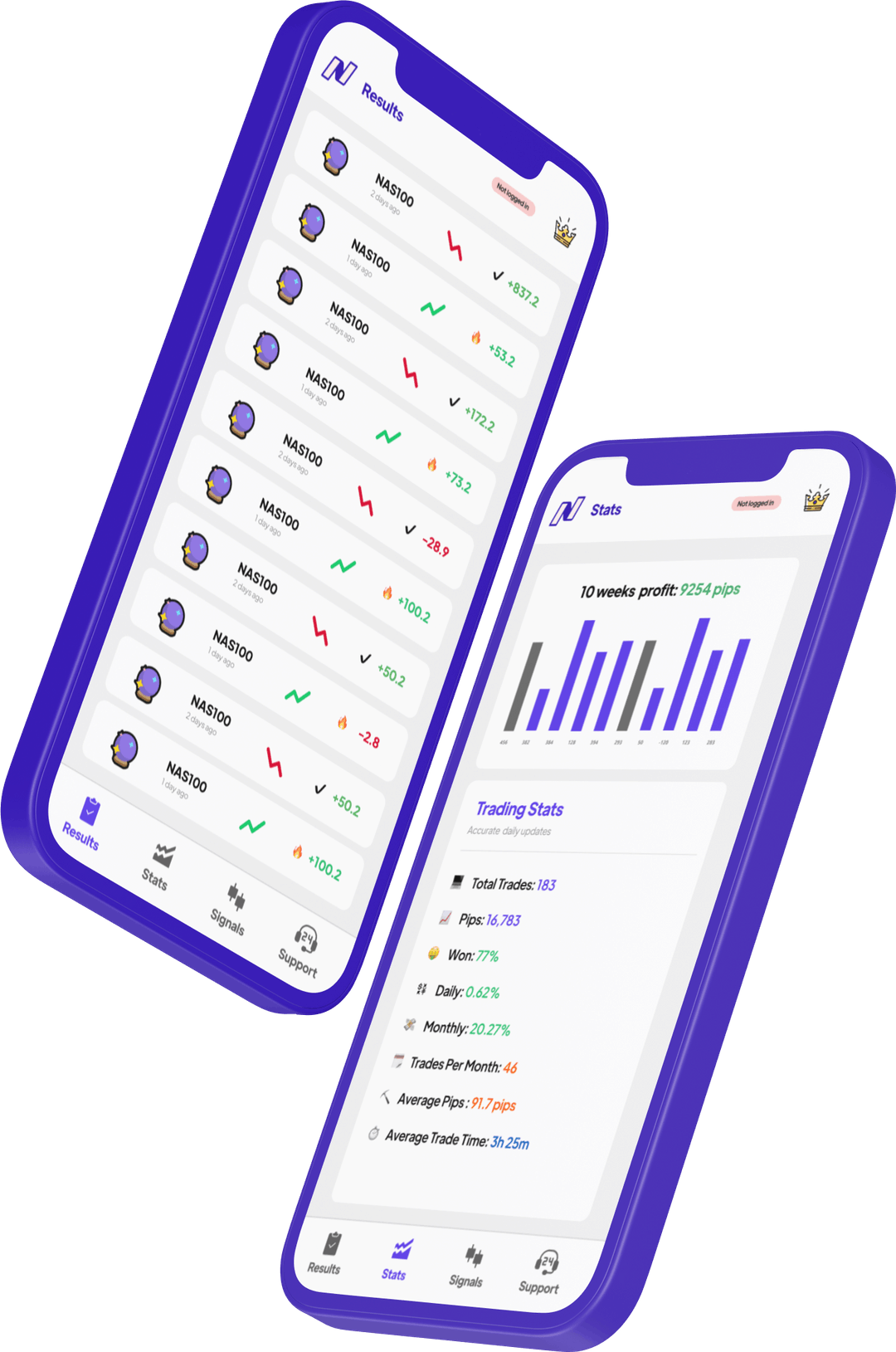
What are MNQ signals?
Understanding MNQ futures
The MNQ (Micro E-mini Nasdaq-100) is a $2 per point futures contract on the CME — exactly 1/10th the size of the standard NQ. It gives retail traders access to Nasdaq-100 price action with manageable margin requirements (typically $1,000–2,000 intraday). MNQ futures signals give you professional-grade entry and exit levels specifically sized for micro contracts.
Why trade MNQ futures
- $2 per point — lower risk per trade
- Same Nasdaq-100 exposure as NQ, 1/10th the size
- Low intraday margin (~$1,000-2,000)
- Perfect for scaling in and out of positions
- Available on every major futures broker
Our MNQ futures signals include.
Watch MNQ futures signals in action.
See real-time Micro Nasdaq-100 trade execution on the NasdaqSignals app.
A feed you can verify.
Every signal we publish is timestamped and price-stamped. Scroll the last few — the same feed you see the second you sign in.
MNQ futures trading strategies.
Scalping
1–30 minQuick 5-15 point MNQ scalps. Tight stops, ideal for micros.
Day Trading
1–8 hoursIntraday MNQ positions. Capital-efficient with micro contract sizing.
Swing Trading
1–5 daysMulti-day MNQ positions on technical setups. Scale into full NQ exposure.
News-Based
MinutesReactive MNQ trades around FOMC, CPI, tech earnings. Lower risk per contract.
MNQ futures specs.
A real MNQ signal breakdown.
The signal
The outcome
How to trade MNQ step by step.
Open a futures broker account
Sign up with a CME-registered broker: NinjaTrader, Tradovate, or AMP Futures. MNQ intraday margin is only ~$1,000–2,000 — you can start with a $500–1,000 funded account. Most brokers offer commission-free Micro trading.
Download the NasdaqSignals app
Install from the App Store or Google Play. Enable push notifications for instant signal delivery. The same professional setups used for NQ are sized for MNQ — you get identical quality on a smaller scale.
Size for micro contracts
MNQ is $2 per point — 1/10th of NQ. A 70-point stop = $140 risk per contract. This makes MNQ ideal for scaling: start with 1–3 micros, size up as your account grows, or use MNQ to test strategies with minimal risk.
Execute and manage
Enter at the specified MNQ price when a signal fires. Set your stop-loss and take-profit levels. Our analysts manage live — you will get SL adjustment updates and move-to-breakeven notifications as the trade progresses.
MNQ vs other Nasdaq vehicles.
| Feature | MNQ | NQ | NAS100 CFD | QQQ |
|---|---|---|---|---|
| Point value | $2 | $20 | Varies by broker | $1/share |
| Min account | ~$500 | ~$5,000 | $100–500 | $500+ |
| Exchange | CME | CME | Broker (OTC) | NASDAQ |
| Trading hours | 23h/day | 23h/day | Broker hours | 9:30–16:00 ET |
| IRA eligible? | No | No | No | Yes |
| Options? | No | Yes (futures opts) | No | Yes |
| Best for | Beginners, scaling | Experienced traders | Forex traders | Stock traders |
Why MNQ traders choose us.
Performance metrics
MNQ futures signals FAQ.
What are MNQ futures signals? ▼
MNQ futures signals are real-time trade alerts for the Micro E-mini Nasdaq-100 futures contract on the CME. Each signal includes a precise entry price, stop-loss in MNQ points, and up to three take-profit targets. At $2 per point, MNQ is ideal for smaller accounts — same professional setups as NQ, sized for micro contracts.
What broker do I need for MNQ futures signals? ▼
You need a futures broker that offers CME Micro products. Popular choices include NinjaTrader, Tradovate, AMP Futures, EdgeClear, and Ironbeam. Most brokers require only $1,000–2,000 intraday margin for MNQ. Signals are delivered via push notification — they work independently of your broker.
What's the difference between MNQ and NQ futures? ▼
The MNQ (Micro E-mini Nasdaq-100) is $2 per point — exactly 1/10th the size of the NQ at $20 per point. MNQ is ideal for newer traders, smaller accounts, or scaling into positions gradually. Same Nasdaq-100 index, same strategy, smaller risk per contract.
Can I trade MNQ signals with a small account? ▼
Yes — MNQ is specifically designed for smaller accounts. With intraday margin requirements as low as $1,000–2,000 per contract and each point worth only $2, you can trade with significantly less capital than the full NQ contract requires. Many traders start with MNQ and scale up to NQ as their account grows.
More Nasdaq trading resources.
NQ Futures Signals
E-mini Nasdaq-100 signals for standard accounts.
NAS100 Signals
Live NAS100 index CFD signals with 93% accuracy.
Best Nasdaq Brokers
Compare brokers for NAS100 and micro futures trading.
Beginner's Guide
Step-by-step: from zero to your first Nasdaq trade.
NAS100 Trading Strategies
Scalping, day trading, swing — strategies for every style.
NAS100 Risk Management
Position sizing, stop-losses, and drawdown protection.
Add a second edge to your NAS100 trading.
If you're already trading NAS100 profitably, NasdaqSignals isn't a replacement — it's a second opinion. Compare our analyst calls against your own setups. Many experienced traders use us to confirm bias or catch setups they'd otherwise miss during off-hours.
- → Use as confirmation for your own analysis
- → Catch setups during sessions you can't watch
- → 93% win rate across 1000+ verified trades
- → No lock-in — view results before subscribing
Gold trading questions, answered.
What is the current gold price per ounce in USD? +
The live XAU/USD gold price updates every 15 seconds on our gold price page. As of May 2026, gold trades above $3,300 per troy ounce. Gold (XAU/USD) trades 24 hours a day, 5 days a week — from Sunday 22:00 UTC to Friday 22:00 UTC. The most liquid sessions are London (07:00–16:00 UTC) and New York (12:00–21:00 UTC).
How accurate are NasdaqSignals XAU/USD signals? +
NasdaqSignals maintains a 93% win rate calculated across all closed XAU/USD trades since 2018. This is verified publicly — every signal (wins and losses) is timestamped and logged in the app. The average winning trade captures 91.7 pips, with an average trade duration of 3 hours 25 minutes. We publish 4–8 signals per trading day.
What does a gold trading signal include? +
Every NasdaqSignals signal includes: exact entry price (or range), stop-loss level, three take-profit targets (TP1, TP2, TP3), suggested lot size based on 1% risk, and the trade direction (BUY or SELL). After entry, we send live management updates — SL adjustments, partial close instructions, and "move to breakeven" alerts.
What moves the gold price? +
Gold (XAU/USD) is primarily driven by 5 factors: (1) US real interest rates — gold is inversely correlated to yields; (2) US Dollar strength (DXY) — weaker dollar = higher gold; (3) Geopolitical risk — wars, sanctions, and elections drive safe-haven demand; (4) Central bank buying — BRICS nations accumulated record gold in 2023–2026; (5) Inflation expectations — gold acts as an inflation hedge when CPI rises faster than expected.
How much capital do I need to trade gold? +
You can start trading XAU/USD with as little as $100–$500 using brokers that offer micro lots (0.01 lot). At 1% risk per trade with a typical 30-pip stop-loss on gold, a $1,000 account would risk $10 per trade with a position size of approximately 0.03 lots. NasdaqSignals signals include lot size recommendations based on your account size.
Which broker should I use for gold trading? +
NasdaqSignals signals work with any broker offering XAU/USD. Popular choices: IC Markets (raw spread $0.05, best for scalpers), Exness (unlimited leverage for pros, instant withdrawals), and Pepperstone (FCA regulated, TradingView integration). Key factors: spread (lower is better — aim for under $0.30), execution speed, regulation, and platform support (MT4/MT5/cTrader).
What is the best time to trade gold? +
Gold is most active during the London-New York overlap (12:00–16:00 UTC), when both sessions are open simultaneously. This period produces the largest moves and tightest spreads. The London session open (07:00 UTC) often sets the day's direction. The Asian session (00:00–07:00 UTC) is quieter — good for range trading but avoid breakout strategies.
Is gold trading risky? +
Yes. Gold (XAU/USD) is one of the most volatile instruments — it regularly moves $30–$80 per day (300–800 pips). With leverage, losses can exceed your deposit. Never risk more than 1–2% of your account per trade. Always use a hard stop-loss. NasdaqSignals includes a pre-calculated stop-loss on every signal to limit downside risk.
Get MNQ futures signals now.
Professional Micro Nasdaq-100 alerts. Free download. No card required.